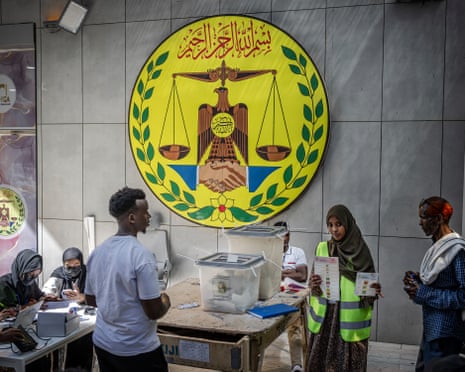
Israel has become the first country to recognise Somaliland as a sovereign state, a breakthrough in its quest for international recognition since it declared independence from Somalia 34 years ago.
The Israeli foreign minister, Gideon Sa’ar, announced on Friday that Israel and Somaliland had signed an agreement establishing full diplomatic relations, which would include the opening of embassies and the appointment of ambassadors.
The recognition is a historic moment for Somaliland, which declared its independence from Somalia in 1991 but until now had failed to be recognised by any UN member states. Somaliland controls the north-west tip of Somalia, where it operates a de facto state, and is bordered by Djibouti to the north-west and Ethiopia to the west and south.
The Israeli prime minister’s office said the declaration was “in the spirit” of the Abraham accords, a series of normalisation agreements between Israel and mostly Arab states signed in 2020.
It posted a video of Benjamin Netanyahu speaking via video call with Somaliland’s president, Abdirahman Mohamed Abdullahi, in which he invited him to visit Israel and described the friendship between the two countries as “historic”. Abdullahi said he would be “glad to be in Jerusalem as soon as possible”.
Israel’s move was condemned by Egypt and Turkey, which said in a statement: “This initiative by Israel, which aligns with its expansionist policy and its efforts to do everything to prevent the recognition of a Palestinian state, constitutes overt interference in Somalia’s domestic affairs.”
Sa’ar said the recognition came after a year of talks between the two countries and that he had instructed Israel’s ministry of foreign affairs to immediately “institutionalise ties between the two countries”.
Israeli analysts have said recognition of the breakaway state could be in Israel’s strategic interest, given Somaliland’s proximity to Yemen, where Israel has conducted extensive airstrikes against the Houthi rebels over the past two years.
A report in November by the Institute for National Security Studies, an Israeli thinktank, said: “Somaliland’s territory could serve as a forward base for multiple missions: intelligence monitoring of the Houthis and their armament efforts; logistical support for Yemen’s legitimate government in its war against them; and a platform for direct operations against the Houthis.”
The Somaliland authorities already host a military base operated by the United Arab Emirates in Berbera, which has a military port and an airstrip for fighter jets and transport aircraft. Analysts have suggested that the base is a key part of the UAE’s anti-Houthi campaign in Yemen.
Somaliland’s president revealed in May that US military officials, including the most senior officer in the Horn of Africa, had visited Somaliland and that another US delegation was expected to visit soon. “It’s a matter of time. Not if, but when and who will lead the recognition of Somaliland,” Abdullahi told the Guardian.
Project 2025, which was published in 2023 and is alleged to have guided much of the doctrine of Donald Trump’s second administration, called for the recognition of Somaliland as a “hedge against the US’s deteriorating position in Djibouti”, where Chinese influence is growing.
This August, the Texas Republican senator Ted Cruz wrote to Trump asking him to recognise Somaliland. Cruz said Somaliland was an ally of Israel and that it had expressed support for the Abraham accords.
The US administration is reportedly split over the recognition of Somaliland, with some fearing such a move could endanger military cooperation with Somalia. The US has troops deployed there, where it supports Somali forces in their fight against the Islamist movement al-Shabaab.
Somaliland has a population of a little more than 6.2 million. The breakaway state has a democratic system that has had peaceful transfers of power, though the Washington-based non-profit organisation Freedom House noted an “erosion of political rights and civic space” in recent years, with journalists and opposition figures facing repression from authorities.