
For years, stablecoins have been marketed as crypto’s potential bridge to normal, everyday payments — or at least what most people consider to be normal.
In 2025, they seemed to have made the jump from a promising prospect to a tool increasingly used by institutions, banks, and even previous crypto non-believers.
Total transaction volumes for stablecoins surged by 72% last year, reaching a massive $33tr (€28tr), according to data from Artemis Analytics.
Stablecoins are crypto assets designed to maintain a stable value by pegging their worth to a real-world asset such as the US dollar. Essentially, they represent a digital copy of a circulating currency.
Since cryptocurrencies are not typically controlled by regular banking institutions and their circulation is not regulated by the monetary policies of governments, monetary institutions were reluctant to use them in their transactions.
Unlike other crypto assets, stablecoins aim to maintain a fixed value relative to a government-issued currency and are backed by that currency, as well as other reserves like treasury bills, to guarantee the token can be redeemed on a 1:1 basis.
Over 90% of stablecoins in circulation today are pegged to the US dollar. The two largest are Tether’s USDT, with a market cap of $186bn (€160bn), and Circle’s USDC, with a market cap of $75bn (€65bn). In 2025, Circle facilitated $18.3tr (€15.7tr) worth of transactions, while USDT racked up $13.3tr (€11.4tr) in transaction volume.
Back in October, a report by a16z, a California-based venture capital firm, also attempted to measure organic stablecoin payments in 2025. The fund concluded that on an adjusted basis, stablecoins had done at least $9tr (€7.7tr) in “real” user payments. This value indicates an 87% increase from 2024 and the report states “it is more than five times PayPal’s throughput and more than half of Visa’s”.
As financial institutions turn their attention to stablecoins, key institutions like the International Monetary Fund are advocating for cooperation among economic blocs to build an international framework for the sector.
However, the current approach to stablecoin issuance and regulation differs significantly among governments in the EU, US, China, and other parts of the world.
What are CBDCs?
Besides stablecoins that are issued and supported by private entities and reserves, central bank digital currencies (CBDCs) have emerged.
These are also digital versions of government-issued currencies, backed by the issuing central bank. However, they do not use decentralised blockchain technology in their core transaction system.
According to McKinsey, cash still accounts for 46% of payments worldwide as of 2025, but non-digital transactions are declining, particularly in developed countries with greater digital infrastructure and financial inclusion.
Governments and central banks understand these changing payment trends, and in many countries, CBDCs offer a viable solution.
China launched its digital yuan (e-CNY) as part of a pilot project in 2019 and the roll-out has since expanded.
As for the EU, the European Central Bank is currently working on a digital euro. In October 2025, the ECB announced that the preparation phase had concluded.

The President of the ECB, Christine Lagarde, stated that “we have done our work, we have carried the water, but it’s now for the European Council and certainly later on for the European Parliament to identify whether the Commission’s proposal is satisfactory”.
The Eurosystem is aiming for a first issuance in 2029.
Trump’s stablecoin strategy
Under the Trump administration, the US has taken the exact opposite approach to CBDCs, in favour of stablecoins.
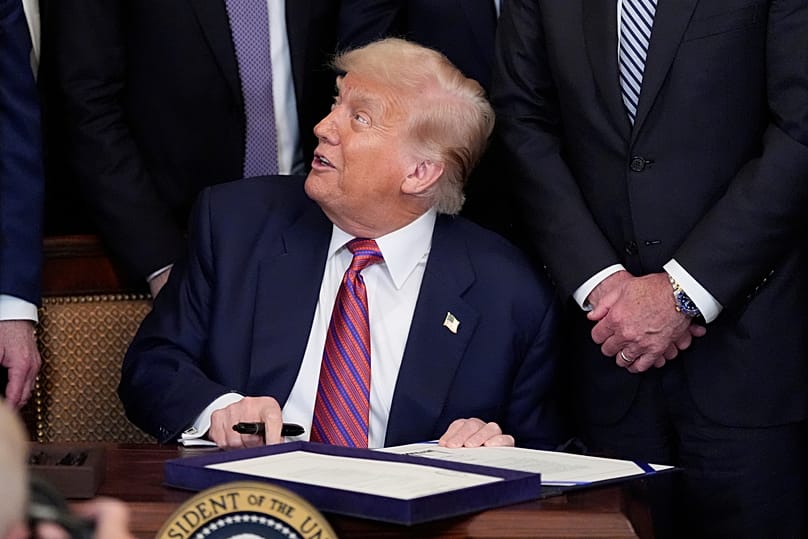
In his first week in office, back in January 2025, President Trump signed an executive order “prohibiting agencies from undertaking any action to establish, issue or promote CBDCs in the US or abroad”.
This cleared the way for USDT, USDC, and all other privately issued US dollar stablecoins to continue to dominate the market without having to compete with an “official” version.
In July 2025, Trump also signed the Guiding and Establishing National Innovation for US Stablecoins Act (GENIUS Act), creating a comprehensive regulatory framework for stablecoins.
Among other provisions, the law requires stablecoin issuers to maintain full reserve backing of their token, on a 1:1 basis, with liquid assets such as US dollars, treasury bills, and bonds.
For the Trump administration, if a US dollar stablecoin issuer is successful, that means they will progressively increase their supply, which requires them to constantly purchase US debt for their reserves.
Stablecoin regulation in the EU
In China, the introduction of the digital yuan also meant the explicit prohibition of stablecoins in the mainland.
However, in the EU, the looming launch of the digital euro has not translated into stablecoin bans.
For now, stablecoin adoption is growing in Europe and stablecoin issuers, together with other crypto firms, have a compliance framework under the EU’s Markets in Crypto-Assets (MiCA) regulation.
By July of this year, the transition period ends for securing a Crypto-Asset Service Provider (CASP) licence, required to operate legally.

The France-based multinational payments provider, Ingenico, announced a partnership with WalletConnect, a protocol that connects crypto wallets with applications, enabling stablecoin payments at scale.
Through a new payment solution called WalletConnect Pay, merchants can accept USDC and EURC, among other stablecoins, using existing Ingenico payment terminals.
WalletConnect’s CEO, Jess Houlgrave, told Euronews that “MiCA is not perfect, nor is it the end-state of crypto regulation in the EU, but some regulatory clarity is better than none”.
Additionally, the CEO underlined that uniform enforcement is important to stop “regulatory shopping” between different jurisdictions, where crypto firms simply choose the version of the rules that suits them best.
Euronews also spoke with the general counsel of Crossmint, Miguel Zapatero. The company provides stablecoin infrastructure for businesses.
With a key base in Spain, Crossmint secured a MiCA licence with the Spanish regulator (CNMV) this week. When asked about the procedure, the general Zapatero said that “the barriers to entry are difficult and costly for small businesses, as the requirements are the same for a major bank or a crypto startup”.
Zapatero added that “once you acquire a CASP licence, businesses trust you more, and other regulators around the world tend to expedite their own procedures with you, as the MiCA is one of the most strict crypto regulations globally”.
These statements echo the EU’s touted doctrine of “regulating by example”, although the risk of overcomplexity looms — threatening to stifle innovation.