Just 12 days into the year, the geopolitical landscape has already been upended by an increasingly brazen US president.
Trump has ordered the capture of Venezuela’s leader, threatened to seize Greenland from Denmark and is coercing Cuba into an oil deal as he aims to push out his adversaries from the Western Hemisphere and cement his sphere of influence.
Now, questions are mounting over whether escalating anti-government protests in Iran could spark US intervention. Overnight, Trump told reporters on Air Force One he was considering “very strong” options in response, with reports that senior officials will present him with concrete options tomorrow.
Speaking live on our flagship morning show Europe Today earlier this morning, former French Prime Minister Dominique De Villepin called on Donald Trump to exercise restraint, saying there are “unofficial ways to pressure the Islamic government” to “halt the current situation”.
“Do not intervene, put as much pressure as you can, try through dialogue and any means to create a new situation that might create the awareness for the Iranian leadership to measure the consequences of their acts,” De Villepin told our chief anchor Méabh Mc Mahon. “Through an intervention, we might create a situation of chaos worse than the situation today.” We lead this morning with the latest, including insider insights from our Persian team.
European Union leaders have been largely sidelined in this shifting world order, hamstrung by internal divisions and a reluctance to alienate Trump amid a push for peace in Ukraine.
But – a major breakthrough in the EU’s trade deal with the South American Mercosur bloc has come just at the right moment for the EU to claw back relevance.
EU countries backed the contested EU-Mercosur free trade deal on Friday after nearly three decades of negotiations, in an unexpectedly timely reminder to Washington that rules-based agreements are not dead.
European Commission President Ursula von der Leyen and European Council President António Costa will sign the agreement next Saturday in Paraguay’s capital of Asunción along with the foreign ministers of Mercosur members Argentina, Brazil, Paraguay and Uruguay, as first reported by Euronews on Friday.
It’s more than just a trade deal. It’s also a major boost to the EU’s credibility on the international stage – and proof it can diversify its geo-economic relations amid an upheaval of the global order.
France, however, the deal’s fiercest opponent, is still hoping it can block its final approval in the European Parliament, as President Macron and the government in Paris emerge rattled from their failure to halt the deal. We have more below on the French fallout.
European leaders condemn Iran’s crackdown on protesters as Trump weighs options
US President Donald Trump will be briefed tomorrow on his options in response to mass protests in Iran, which include military interventions, sanctions on the Iranian regime, or campaigns to support anti-government movements, officials have told the Wall Street Journal (WSJ).
“We’re looking at it very seriously – the military’s looking at it. And we’re looking at some very strong options,” Trump said hours ago. “I’m getting an hourly report, and we’re going to make a determination.”
Tehran has meanwhile warned that US military bases and Israel would be “legitimate targets” if the US were to strike the Islamic Republic in support of demonstrators.
The WSJ also reports that the US has not mobilised any forces in preparation for potential military strikes, but that the administration could discuss sending Elon Musk-owned Starlink terminals in a bid to restore internet connectivity.
It comes amid reports from activist groups that at least 544 demonstrators have been killed as a result of an intensified crackdown on protests by the Iranian authorities. Verified videos of large rallies in cities across the country have emerged despite the country plunged into a complete internet shutdown since Thursday evening.
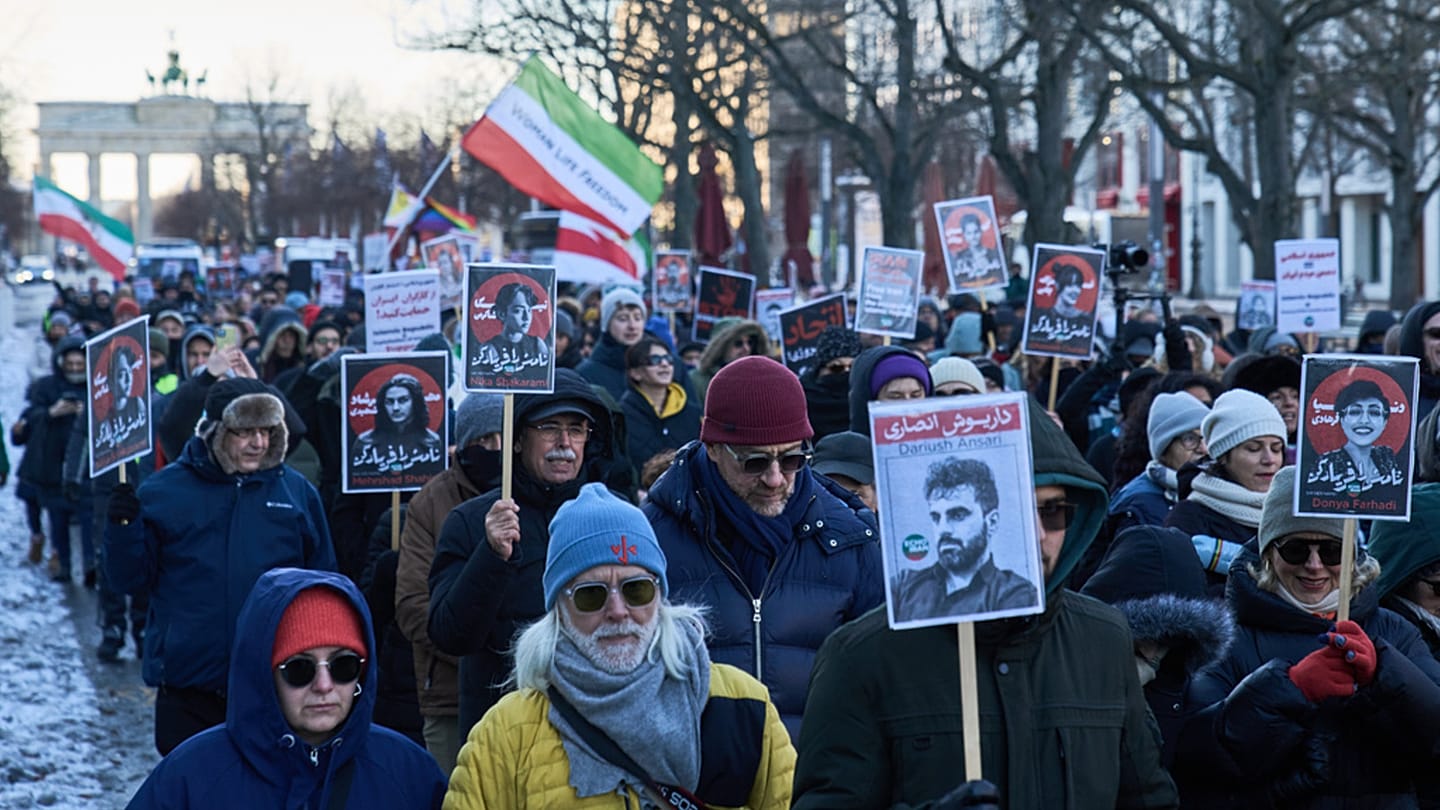
The demonstrations present one of the biggest challenges to the rule of supreme leader Ayatollah Ali Khamenei, amid deepening dissatisfaction over skyrocketing prices and economic turmoil. Over the weekend, protests in solidarity with the Iranian people erupted on the streets of cities in France, Germany, the Netherlands and the UK.
Analysts speaking to Euronews’ Persian service say that the coming hours will be “critical” in determining whether this is a turning point in Iran, and should indicate whether protests continue to spread despite the crackdown, or whether they are violently suppressed by the regime.
Our Persian colleagues also write that the interventions of Reza Pahlavi, the exiled son of Iran’s last shah (king) – who seems to be seeking a role in the country’s potential transition – are also raising the stakes and drawing international interest, despite Pahlavi being a divisive figure. My colleague Omid Lahabi has an in-depth read on Pahlavi and his vision for Iran’s polity.
Meanwhile, European leaders have issued words of support for demonstrators and of caution for the authorities. Commission President von der Leyen said on Saturday that the EU “unequivocally condemn(s) the violent repression” of “legitimate demonstrators”.
The leaders of France, Germany and the UK issued a similar statement calling on Tehran to “exercise restraint” and “refrain from violence”.
European Parliament President Roberta Metsola said protestors needed “more than just words”, saying the EU should designate the Islamic Revolutionary Guard Corps and further extend sanctions on individuals propping up the regime. Brussels has in recent years resisted calls to follow the US’s lead and blacklist the IRGC, saying it first requires a court in one of the bloc’s 27 members to rule against the IRGC for acts of terror.
European countries considering NATO mission in Greenland in response to Trump’s annexation threats
A group of European NATO allies spearheaded by the UK and Germany is mulling plans to deploy a military mission to Greenland in a show of defiance faced with Trump’s threats to seize the territory, according to reports by Bloomberg.
Sources familiar with the talks reportedly said that Germany had floated setting up a joint NATO mission designed to protect the Arctic region.
It’s another signal of increasing nervousness in European governments about Trump’s annexation threats and their implications for the NATO military alliance, of which both the US and Denmark – which rules Greenland as a self-governing, autonomous territory – are members.
Danish Prime Minister Mette Frederiksen ramped up the tone of her warnings yesterday, framing possible US intervention in Greenland as a “decisive moment” for her country and for the NATO Alliance.
“We are at a crossroads and this is a decisive moment,” Frederiksen told a political rally, confirming the planned meeting between US Secretary of State Marco Rubio and the foreign ministers of both Denmark and Greenland later this week.
Macron, overruled in Brussels on Mercosur, faces further turmoil at home
France has been plunged into further political turmoil, with the government led by Prime Minister Sébastien Lecornu facing two possible no-confidence motions after Paris failed to block the approval of the EU-Mercosur free trade deal in a vote in Brussels on Friday.
After weeks of fierce farmers’ protests and mounting pressure from all sides of the political spectrum at home, Macron opposed the deal negotiated between Brussels and the South American Mercosur bloc, but the French government failed to rally the necessary blocking minority in a vote among EU countries.
Lecornu responded to criticism from the far right on Sunday, claiming the vote had not been “posturing” but a “resounding no” to “protect agriculture and food sovereignty,” highlighting the concessions clinched by Paris, which include early access to €45 billion from the Common Agricultural Policy and a retroactive freeze of the EU carbon border tax on fertilisers.
Yet his government is pinning hopes on a last-minute bid to tumble the deal when it goes to a vote in the European Parliament, despite the agreement being provisionally implemented before that vote. “The European Parliament must now make its decision,” Lecornu said.
Former French Prime Minister Dominique De Villepin told Europe Today this morning that there is “very strong consensus here in France among all political parties to refuse such an agreement, based on the idea that there is not enough reciprocity.”
“We should have been negotiating to better the deal,” De Villepin, who in June last year launched his own political party, La France Humaniste, said.
Our trade reporter Peggy Corlin writes that Macron was effectively sidelined at a turning point moment for the European Union, which has been wrangling over the deal for decades, in the clearest signal yet that his domestic troubles are undermining his Brussels clout.
It follows Commission President von der Leyen’s ousting of powerful French commissioner Thierry Breton and the appointment of his successor to a much narrower portfolio, which has clearly undercut France’s sway on the policies coming out of Brussels.
More from our newsrooms
‘I suggest they make a deal now before it is too late’ says Trump as he threatens Cuba. US President Donald Trump suggested that Cuba should strike an oil deal with Washington as he warned that the Caribbean nation would no longer receive oil or money from Venezuela – Havana’s decades-long supplier and close partner. Malek Fouda has more.
US launches new retaliatory strikes against IS in Syria after deadly ambush. The large-scale strikes come in retaliation to an ambush attack in December, in which two US soldiers and one US civilian interpreter were killed. Read.
Owner of Swiss bar in New Year fire admits service door was locked from the inside. New details have emerged about the devastating fire at the Le Constellation bar in the Swiss ski resort of Crans-Montana, which claimed 40 lives on New Year’s Eve, showing that a service door in the basement was locked from the inside. Read.